
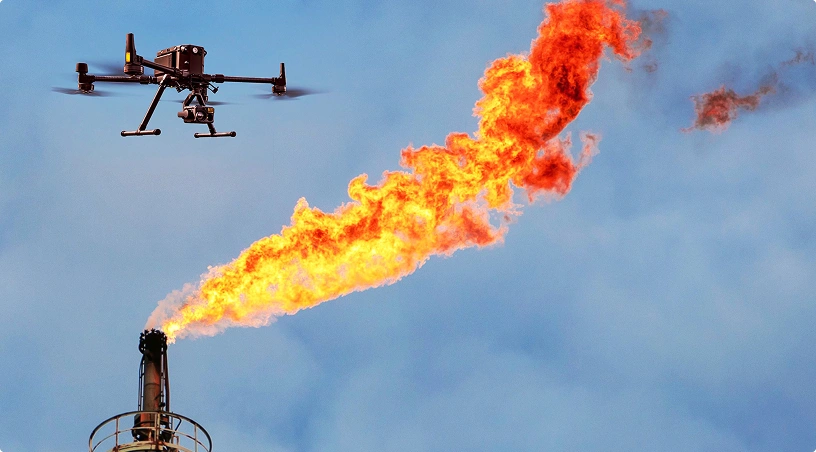
If your flare stack inspection still depends on scaffolding, rope access, or a full production shutdown, inspection cycles can become infrequent, expensive, and operationally disruptive. Flare systems operate at extreme temperatures, in corrosive atmospheres, and often in locations that make close human access dangerous. The result? Many facilities push inspections to turnaround windows, leaving months or years between assessments. In many facilities, this results in long gaps between assessments, during which combustion inefficiencies, refractory degradation, and structural stress can develop without clear visibility.
This blog breaks down the operational challenges behind flare stack inspections, explains how aerial thermal imaging changes the equation, and outlines a practical framework for detecting combustion issues while your facility stays online.
Flare stacks are, by design, some of the hardest assets to inspect. They burn continuously, sit at elevation, and produce radiant heat that creates exclusion zones. Traditional inspection methods require cooling the stack, building scaffolding, and shutting down the associated process unit. For a mid-size refinery in the GCC, this could introduce cost, safety considerations, and production impact.
Because of this cost and complexity, many operators defer flare inspections to planned turnarounds every three to five years. During the gap, incomplete combustion leads to excess emissions and regulatory penalties. Corrosive byproducts (SO₂, H₂S-derived compounds) may accelerate internal wear. Flame instability goes unrecognized until it triggers a visible smoking event or a safety incident.
The barrier is not awareness. Operations and integrity teams understand the risk. The problem is access: getting accurate, real-time data from an active flare system without compromising production or personnel safety. And when inspections do happen during turnarounds, the flare is cold and offline, meaning the data collected tells you about the structure but reveals nothing about how the system actually performs under combustion.
Thermal inspections use calibrated infrared sensors to capture temperature distribution across the entire flare structure while it remains operational. Unlike visual inspections conducted during shutdowns, thermal data collected during live combustion provides a far more accurate picture of system performance.
Combustion inefficiency zones. Uneven heat distribution across the flare tip indicates incomplete combustion, often caused by blocked nozzles, improper air-fuel mixing, or steam injection imbalances. These issues are invisible during a shutdown because the flare is not firing.
Internal corrosion and refractory degradation. Hotspots on the external stack surface may indicate potential areas where internal refractory lining has eroded and should be validated with additional data. By mapping temperature gradients along the wall, inspection teams can pinpoint degradation without sending anyone inside.
Structural stress points. Thermal cycling concentrates stress at welds, flanges, and support brackets. Infrared data reveals localized temperature anomalies at these joints, flagging potential fatigue cracks before they propagate.
Pilot flame and ignition issues. Inconsistent pilot operation is a common source of smoking events and emission spikes. Thermal imaging verifies pilot flame presence and stability across all burner arrays in a single pass, catching irregularities that ground-level visual checks routinely miss. For facilities running multiple flare tips, this capability alone can prevent the kind of intermittent flaring violations that draw regulatory attention.
The key operational advantage is that all of this data is collected under normal load conditions, which is essential. In fact, live operating conditions are required to identify combustion performance issues accurately. A cold stack reveals nothing about flame behavior, heat distribution, or active corrosion patterns.
The shift that makes shutdown-free inspection possible is the move from ground-level methods to enterprise aerial platforms equipped with high-resolution thermal and visual sensors. These systems operate safely within approved standoff distances from active flares, capturing infrared data at angles ground-based cameras cannot reach.
A typical thermal flare stack inspection follows a structured workflow:
Mission planning and risk assessment. The inspection team coordinates with facility operations to align on exclusion zones, wind conditions, and SIMOPS protocols, integrating with your permit-to-work procedures including hot work permits where applicable. Environmental factors like ambient temperature, solar radiation, and wind speed are documented to ensure thermal data quality.
Multi-angle thermal data capture. The aerial platform conducts orbits at varying altitudes, producing a complete temperature profile from base to tip, including support structures and connected piping. Dual-sensor payloads capture both thermal and high-resolution visual data simultaneously, providing the context needed to correlate temperature anomalies with visible surface conditions.
AI-assisted analysis and defect classification. Raw thermal data is processed through analytics platforms that automatically classify anomalies by type and severity. Corrosion indicators, refractory failures, and combustion irregularities are geo-tagged and ranked by risk priority, replacing manual interpretation with consistent, repeatable analysis. This is particularly valuable for facilities managing multiple flare systems across different sites, where standardized defect classification ensures maintenance decisions are comparable across assets.
Structured reporting and integration. Deliverables include annotated thermal images, visual reference imagery, severity assessments, and recommended maintenance actions. Reports integrate directly with asset management systems like SAP or Maximo, enabling work order generation without manual data re-entry. Historical inspection data is retained for trend comparison, giving integrity teams a growing baseline to measure degradation over time.
The entire process, from deployment to preliminary findings, completes within hours. And because the facility remains fully operational throughout, there is zero production impact.
Temperature distribution uniformity is the most immediate indicator of combustion quality. A well-functioning flare shows even heat distribution across the tip. Cold spots or asymmetric patterns suggest blocked nozzles or mechanical damage affecting gas flow. When detected early, these issues can often be resolved through targeted nozzle cleaning or adjustment rather than a full tip replacement.
Stack wall temperature gradients reveal refractory conditions. A healthy stack shows gradual temperature reduction from the combustion zone downward. Sudden spikes along the wall indicate refractory loss, and their location and intensity determine urgency. Left unaddressed, refractory failure accelerates external shell corrosion and can compromise the stack’s structural rating.
Trend data across inspection cycles is where the real value compounds. Comparing thermal profiles over time reveals degradation rates and the effectiveness of past maintenance. Facilities that build a historical baseline from recurring aerial inspections shift from reactive repair to condition-based planning, scheduling interventions based on actual asset condition rather than fixed calendar intervals.
Emission correlation ties thermal data to environmental compliance. Combustion inefficiencies detected through thermal analysis often correlate directly with excess flaring emissions. Identifying and correcting these issues proactively helps facilities stay ahead of tightening environmental regulations across the GCC, where monitoring and reporting standards continue to evolve. For operations teams managing emissions targets, thermal inspection data provides the evidence needed to justify corrective maintenance before a compliance audit forces the issue.
The cost profile of aerial thermal inspections also supports higher inspection frequency. Where a conventional scaffolding-based method might justify only one assessment per turnaround cycle, the significantly lower cost and zero-shutdown requirement of aerial approaches makes it practical to inspect quarterly or semi-annually, building the kind of trend data that transforms maintenance from reactive to predictive.
Thermal flare stack inspections conducted from the air represent a fundamental shift in how facilities manage one of their most difficult-to-access assets. To recap:
Combustion inefficiencies, internal corrosion, and structural stress are best detected while the flare system is operating, not during a cold shutdown. Calibrated infrared sensors on enterprise aerial platforms capture complete temperature profiles without scaffolding or production interruption. AI-powered analytics transform raw thermal data into prioritized, actionable findings that integrate with existing maintenance workflows. And recurring inspections build trend data that supports the shift from reactive repair to condition-based maintenance, reducing both unplanned downtime and compliance risk.
Facilities that adopt this approach gain earlier visibility into degradation, lower per-inspection costs, and a continuous record of asset condition that satisfies both internal integrity standards and regional HSE requirements.
Gulfnet provides drone-based thermal and electrical inspection services purpose-built for oil and gas assets across the GCC. From flare stacks and pipelines to offshore platforms and storage tanks, our certified inspection workflows, advanced sensors, and analytics platform help you detect problems earlier, without stopping production. Request a consultation to scope your next flare stack inspection.
Can thermal inspections detect flare stack combustion problems while the system is still running? Yes. Thermal inspections are specifically designed to be performed while the flare is operating under normal load. Live conditions are actually required to identify combustion inefficiencies, uneven flame distribution, and heat anomalies. A cold, shut-down stack cannot reveal how the system performs during active operation. What types of flare stack defects can infrared drone inspections identify? Aerial thermal inspections detect combustion inefficiency zones, internal refractory degradation, external corrosion hotspots, structural stress at welds and flanges, and pilot flame instability. These defects are mapped, geo-tagged, and classified by severity using AI-assisted analytics, giving maintenance teams a prioritized action plan. How do thermal flare inspections help meet GCC environmental and HSE compliance requirements? Combustion inefficiencies directly contribute to excess flaring emissions. Thermal inspections identify these issues early, allowing corrective action before they trigger regulatory penalties. Structured, audit-ready reports with geo-referenced imagery and defect classifications provide the verifiable documentation required by regional HSE standards. How much do drone-based flare stack inspections cost compared to traditional scaffolding methods? Facilities across the oil and gas sector typically report 60 to 75 percent cost savings compared to conventional scaffolding and rope-access inspections. The savings increase further when factoring in eliminated production downtime, since the facility continues operating at full capacity throughout the aerial inspection process. How often should thermal flare stack inspections be scheduled for optimal asset integrity? Inspection frequency depends on asset criticality and operating conditions. High-criticality flare systems in continuous operation benefit from semi-annual or quarterly inspections. Lower-criticality systems typically require annual assessments. The low cost and zero-shutdown requirement of aerial methods makes higher inspection frequency practical and cost-effective.


 Go back