Inspecting the underside of a highway overpass on Sheikh Zayed Road means closing lanes, deploying a snooper truck, coordinating with RTA traffic management, and putting a team underneath live traffic in 45°C heat. The inspection might take a full day for one structure. Multiply that across the hundreds of bridges, flyovers, and elevated interchanges across Dubai, Abu Dhabi, and the Northern Emirates, and the backlog becomes structural rather than operational. RTA’s 2025-2027 Strategic Plan includes 115 new bridges and tunnels on top of the existing network, each of which will need inspection within years of completion.
This blog covers where drone-based bridge inspection removes the access bottleneck, what it actually captures that conventional methods struggle to reach, and how the data feeds into the asset management decisions that keep structures safe and serviceable.
Bridge inspection is unlike any other infrastructure inspection because the most critical surfaces face downward. Deck soffits, bearing shelves, expansion joints, pier caps, and cross-heads all sit underneath the structure, out of reach without specialist access equipment.
In the UAE, the access problem compounds. Snooper trucks and under-bridge inspection units require lane closures on roads carrying some of the highest traffic volumes in the region. RTA and Abu Dhabi Mobility permit windows are limited, nighttime work carries its own safety overhead, and summer heat restricts how long a crew can work at height before fatigue becomes a risk. Marine crossings, creek bridges, and coastal flyovers add a further layer: some pier substructures can only be reached by boat, and tidal windows narrow the available time further.
The result is that many structures get inspected less often than their exposure demands. Not because the asset owner does not care, but because the logistics of getting eyes on the right surfaces are expensive, slow, and disruptive enough to push inspections into the next budget cycle.
Concrete structures in the UAE face an aggressive exposure environment. Chloride ingress from coastal air and sabkha groundwater attacks reinforcement through the cover concrete. Thermal cycling between 50°C surface temperatures and air-conditioned deck undersides stresses joints, bearings, and waterproofing membranes. Carbonation progresses faster in dry, high-CO2 urban corridors than textbook European rates predict.
When inspections fall behind, the progression from cosmetic defect to structural concern accelerates unseen. A hairline soffit crack at 0.2 mm may have opened to 0.5 mm and begun showing corrosion staining. A bearing pad may have walked out of position under repeated thermal loading. An expansion joint seal may now be allowing water onto the bearing shelf, initiating the corrosion cycle that will eventually require a far more expensive intervention.
Each defect is repairable when caught early. Each becomes a structural remediation project when caught late. The cost difference is often an order of magnitude.
Also read: DJI Enterprise Drones for Industrial Inspection: Why Leading UAE Companies Choose Them
A properly scoped drone inspection works through the structure systematically, matching sensor and flight path to each element.
Deck surface condition is captured from above using high-resolution RGB and thermal imaging. Thermal imaging helps identify temperature variations associated with subsurface conditions such as delamination, moisture presence, or material inconsistencies beneath the wearing course, supporting faster and more targeted structural assessment workflows.
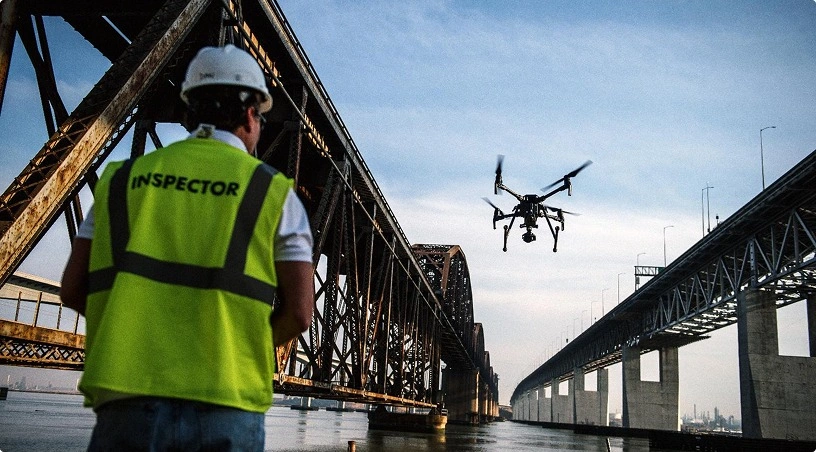
Soffit and underside inspection is where drones remove the access bottleneck entirely. Platforms capable of flying beneath the deck, close to the concrete surface, capture crack mapping imagery, spalling, exposed reinforcement, and efflorescence at resolution sufficient for crack-width measurement. This is the work that previously required a snooper truck, scaffolding, or rope access, all of which demand lane closures and specialist crews.
Bearings, expansion joints, and drainage outlets sit in the hardest-to-reach zones of any bridge. Close-range visual and thermal capture from a drone can identify bearing displacement, joint seal failure, blocked drainage, and corrosion on steel components without dismantling or physical contact.
Pier substructure and pile caps, particularly on marine crossings and creek bridges, benefit from AI-assisted defect detection applied to high-resolution capture. Tidal zone concrete, scour patterns around foundations, and marine growth that masks underlying damage all become visible and recordable without boat-based access.
Approach embankments and abutment walls complete the picture: settlement cracking, drainage failure, and slope erosion are captured in the same mission that covers the main span.
Raw imagery is not an inspection report. The value sits in what happens between capture and decision.
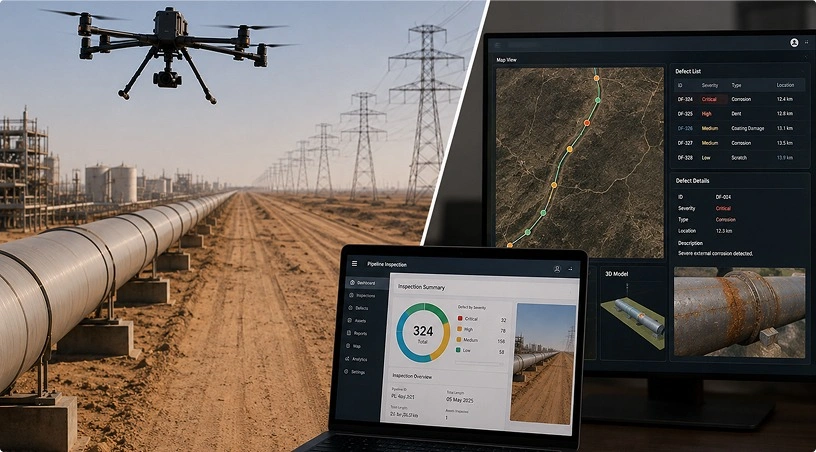
Photogrammetric processing converts drone imagery into 3D models and orthomosaics of each structural element, georeferenced and measurable. Crack widths, spall areas, and bearing offsets can be quantified rather than described. Managed data pipelines with AI-powered analytics classify defects by type, severity, and location, producing structured condition reports that feed directly into bridge management systems.
Condition scoring against a defined scale allows asset owners to compare structures across a portfolio and prioritise intervention based on structural risk rather than inspection date. Trend tracking across successive inspection cycles shows whether a defect is stable, progressing slowly, or accelerating, which is the information maintenance engineers actually need to decide between monitoring, repair, and replacement.
For GCAA-compliant operations on structures near airports, heliports, or restricted zones, pre-cleared permits and experienced regulatory handling ensure that flying beneath a bridge deck does not create an airspace compliance issue that delays the programme.
Also read: Power Line Inspection Using Drones: Reducing Outage Risk for UAE Utilities
UAE bridge infrastructure is growing fast and ageing simultaneously. New structures need baseline inspections within their first years of service. Existing structures carrying decades of thermal cycling, chloride exposure, and traffic loading need inspection cadence that matches their actual condition trajectory, not a generic five-year cycle. Drone-based inspection removes the access constraint that has historically made that cadence unaffordable, captures data at a resolution that manual methods struggle to match, and feeds it into systems where the asset management decision actually gets made. The structures are there. The exposure is there. The question is whether the inspection programme can keep pace.
Related: Construction Progress Monitoring ROI: How Drones Reduce Project Delays
Gulfnet Emirates is an authorised DJI Enterprise dealer supporting infrastructure owners, road authorities, and engineering consultants across the UAE and GCC with platform supply, GCAA-compliant pilot teams, managed bridge inspection services, payload configuration, and AI-powered structural analytics through its Drones and Robotics division.
Visit gulfnetemirates.com/dronesandrobotics to design an inspection programme that fits your asset portfolio.
Can drones inspect the underside of a bridge without lane closures?
Yes. Enterprise-grade platforms fly beneath the deck from launch positions that do not require lane occupation, capturing soffit imagery, bearing condition, and expansion joint detail without traffic disruption. This eliminates the snooper truck and associated RTA or Abu Dhabi Mobility permit coordination that traditionally drives inspection cost and scheduling delays.
What structural defects can drone bridge inspection detect?
High-resolution RGB identifies concrete cracking, spalling, exposed reinforcement, efflorescence, and joint seal failure. Thermal imaging detects subsurface delamination, moisture ingress, and voiding beneath the wearing course. LiDAR supports 3D modelling for settlement monitoring and clearance measurement. Defect severity is classified for direct input into bridge management systems.
How does drone bridge inspection data integrate with asset management systems?
Processed imagery converts into georeferenced 3D models and structured condition reports with defect classification, severity scoring, and location mapping. These outputs feed into bridge management systems and GIS platforms, enabling portfolio-level prioritisation, trend tracking across inspection cycles, and defensible maintenance planning tied to structural risk.
Are drone bridge inspections compliant with UAE aviation regulations?
Yes. Per the UAE Government’s aviation safety framework, commercial operations require GCAA Unmanned Aircraft Operator Authorisation, registered aircraft, certified pilots, and per-flight permits. Bridge structures near airports or restricted airspace need additional clearances that experienced operators manage as part of programme delivery.
Which DJI Enterprise drones are suited for bridge inspection in the UAE?
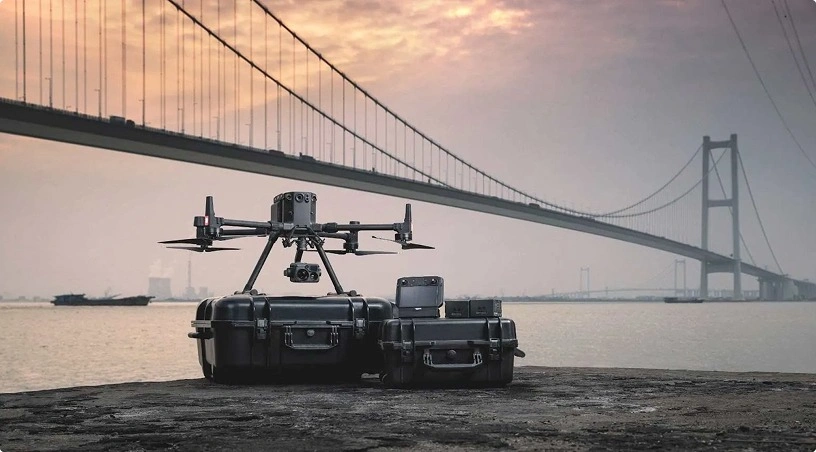
The DJI Matrice 400 RTK supports multi-sensor payloads including high-zoom visual, thermal, and LiDAR for comprehensive structural surveys. The Matrice 4T handles agile under-deck and pier inspection at close range. Platform choice follows structure type, access geometry, and downstream data requirements.
 Go back