A 4 mm leading-edge erosion patch on a coastal turbine blade looks like nothing in a routine ground photo. Six months of salt-laden gusts and sand abrasion later, that same patch can pull a turbine offline for weeks and trigger a warranty dispute over whether the OEM coating performed to spec. Every hour parked is lost generation, missed PPA volumes against EWEC, and a slipping line on the asset’s IRR. With the UAE Wind Program putting 103.5 MW of utility-scale wind onto the grid across four sites, asset availability is now directly tied to whether the country hits its clean energy commitments.
This blog covers how drone-based inspection catches that 4 mm patch before it costs you the blade, where the financial logic sits, and what to look for in an inspection partner.
Wind asset financials are unforgiving when inspection cadence falls behind degradation rate, and on UAE coastal sites, every gap in coverage exposes more than one budget line at once.
Lost generation revenue accumulates from the moment a turbine goes offline, whether for an unplanned shutdown or a confirmed defect awaiting repair. PPA volume shortfalls then cascade into liquidated damages or merit-order penalties depending on contract terms. Premature blade replacement, often running into hundreds of thousands of dollars per blade plus crane mobilisation, becomes the default when defects are caught at the structural rather than cosmetic stage. Warranty claims weaken when the operator cannot produce timestamped evidence of when a defect first appeared. Insurance premiums rise on portfolios where condition data is thin, particularly on coastal sites where underwriters now expect documented evidence rather than calendar-based assumptions.
The cost of a thorough inspection programme is small relative to any one of these exposures. The cost of skipping one is rarely contained to a single line.
The question for most UAE operators is not whether drones are better than rope access; it is whether the switch changes the maths enough to justify re-engineering the O&M workflow. It does, and the case sits on three legs. Cadence becomes affordable. Where rope access supports one full inspection per turbine per year, drone capture supports quarterly intervals or tighter on coastal sites without proportional cost increases. That cadence catches a 4 mm erosion patch while it is still a coating issue rather than a composite issue.
Data quality becomes defensible. High-resolution RGB capture at OEM-acceptable resolution, paired with radiometric thermal payloads and georeferenced metadata, produces records that hold up in warranty disputes, insurance claims, and regulatory filings. Managed inspection programmes with AI-assisted defect classification shorten the gap between capture and actionable reporting further still.
Risk shifts off the technician. Tower climbs, suspended blade access, and weather-window dependencies all compress when the technician stays on the ground. HSE incident exposure on inspection days drops to near zero on properly structured flight operations with GCAA-certified pilots.
Specific defect types drive the inspection scope, and each one calls for a different sensor or capture technique.
1. Leading-edge erosion shows up as surface coating loss progressing toward the laminate. High-resolution RGB capture at sub-millimetre detail flags it early enough to schedule recoating rather than blade repair.
2. Lightning strike damage often combines visible exit-point burns with hidden internal arcing along the down-conductor path. Thermal capture during operation, where permitted, identifies resistive hotspots that visual inspection misses.
3. Composite cracks and trailing-edge splits appear at structural stress points and propagate quickly under fatigue loading. Repeatable flight paths captured against a baseline make crack growth tracking straightforward across cycles.
4. Delamination and bond-line failures sit beneath the surface and rarely show up visually until they have affected stiffness. Radiometric thermal payloads detect the air gaps and moisture pockets that signal early delamination.
5. Surface contamination, including sand pitting, salt deposition, and biological fouling, degrades aerodynamic performance even when no structural damage exists. Tracking surface condition over time tells operators when a cleaning cycle, rather than a repair, will recover lost AEP.
6. Tower, nacelle, and hub-area inspection adds another layer: bolt corrosion, paint failure, oil leaks at the nacelle base, and lightning protection continuity all benefit from the same drone-captured imagery.
The choice between methods comes down to four operational variables: time per turbine, cost per inspection, weather sensitivity, and data quality.
Rope access remains the fallback for hands-on tactile inspection and minor in-situ repairs. It delivers physical blade contact but takes hours per turbine, exposes technicians to height risk, and produces inconsistent photographic records.
Crane-based inspection allows blade access at height with stability for instrument-based testing. It is slow to mobilise, expensive, requires road access and lay-down area, and is impractical on remote island sites like Sir Bani Yas or Delma.
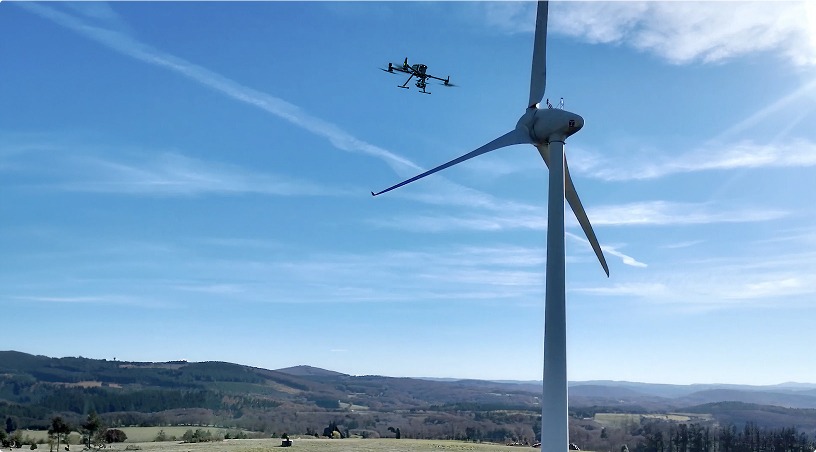
Drone-based capture typically takes 15–45 minutes per turbine depending on blade length, inspection scope, and payload configuration. It requires the turbine to be parked but no scaffolding or crane, producing consistent OEM-resolution imagery, and integrating with AI-driven defect classification and digital twin workflows. It is now the default for routine condition assessment, with rope access reserved for tactile follow-up and crane work for repair execution.
For UAE operators running multi-site portfolios across coastal and island locations, the logistics savings alone often justify the shift before data quality is factored in.
Wind turbines on UAE coastal and island sites degrade faster than inland European benchmarks predict, and the financial consequences of falling behind on inspection cadence concentrate on lost generation, blade replacement costs, and weakened warranty positions. Drone-based inspection makes the right cadence economically viable, produces defect-specific data traditional methods cannot match, and lets operators move inspection from a calendar-driven cost line to a condition-driven asset protection function. The investment case writes itself once the first prevented blade replacement is in the books.
Gulfnet Emirates is an authorised DJI Enterprise dealer supporting renewable energy operators across the UAE and GCC with platform supply, GCAA-compliant pilot teams, managed wind turbine inspection, payload configuration, and AI-powered defect analytics through its Drones and Robotics division. Whether you are protecting a single coastal site or scaling across a multi-site portfolio, the team can help you design a cadence and reporting workflow that fit your O&M strategy, PPA obligations, and warranty positioning. The same platforms also support solar thermal audits, substation inspection, and broader industrial asset workflows across renewable portfolios. Visit gulfnetemirates.com/dronesandrobotics to start the conversation.
What resolution is needed for drone wind turbine inspection imagery to be warranty-grade?
OEMs and insurers typically expect inspection imagery in the range of 0.3–1.0 millimetres per pixel, depending on the defect type and specific manufacturer requirements. Achieving that depends on payload selection, flight distance from the blade, lighting, and gimbal stability. DJI Enterprise platforms paired with high-zoom payloads consistently meet this threshold under proper mission planning.
Can drone thermal imaging detect internal blade damage that visual inspection misses?
Yes. Radiometric thermal capture identifies subsurface delamination, moisture ingress, bond-line failures, and resistive hotspots from lightning damage that RGB inspection cannot see. Thermal sensitivity at or below 50 mK on enterprise-grade payloads is sensitive enough for routine subsurface assessment when missions are flown under appropriate atmospheric conditions.
Are drone wind turbine inspections legal at UAE renewable energy sites?
Yes. Per the UAE Government’s aviation safety framework, commercial drone operations require GCAA Unmanned Aircraft Operator Authorisation, registered aircraft, certified pilots, and per-flight permits. Remote island and coastal infrastructure typically require additional security and access clearances that authorised partners manage as part of the service.
How long does a complete drone inspection of a single wind turbine take?
Automated flights for a single turbine typically run between fifteen and forty-five minutes depending on hub height, blade length, payload configuration, and required image overlap. The turbine must be parked and locked in a defined orientation. Total downtime per turbine is significantly shorter than rope access or crane-based alternatives.
What deliverables should a wind turbine inspection report include?
A defensible report includes high-resolution RGB and thermal imagery, defect classification with severity rating, location mapping on each blade and component, comparison against prior cycles, recommended repair actions with priority, and exportable formats for OEM warranty submission and insurance filing. Reports without these elements are difficult to act on operationally.

 Go back