The hard part of buying a drone inspection service in the UAE is not finding a provider willing to fly. It is knowing what should happen at each stage so you can tell whether the service you are paying for is actually going to deliver findings your maintenance team can act on. Operators new to drone inspection often approve a scope, wait for a report, and only discover at delivery that the flight parameters, the analysis depth, or the format do not match what they needed.
This guide sets out what should happen at each stage of a UAE drone inspection project, from planning through delivery, so you can judge quality at every checkpoint instead of only at the end.
The planning stage is where most avoidable problems get baked in. A competent scoping conversation covers three things: what the operator actually needs to know, what capture parameters produce that output, and what regulatory clearances are needed to fly. Skipping any of these leads to rework.
On the technical side, planning should produce a documented flight plan specifying altitude, overlap ratios, payload configuration, ground control point layout, and coordinate reference system. On the regulatory side, GCAA approvals need to be filed with enough lead time. Flights near controlled airspace, populated areas, or sensitive infrastructure require additional clearances that can take weeks. Also Read: Choosing a Drone Inspection Provider for how planning capability separates competent providers from the rest.
Once planning and clearances are in place, the flight itself should be routine. A well-run capture shows visible discipline in three areas: safety, adherence to plan, and data verification on site. GCAA-certified pilot teams brief the site team before takeoff, confirm airspace status, and fly the planned route without deviations unless conditions require it. Wind, temperature, and dust affect UAE drone operations more than most other environments, so pilots should be checking conditions continuously and standing down when limits are exceeded.
The often-missed step is on-site data verification. Before the pilot leaves site, the imagery should be checked for coverage gaps, focus issues, and payload errors. A capture that gets flagged back at the office two days later means a return trip and a delayed report. On managed programmes, dock-based autonomous operations remove some of this by launching repeat flights automatically, but the verification principle still applies.
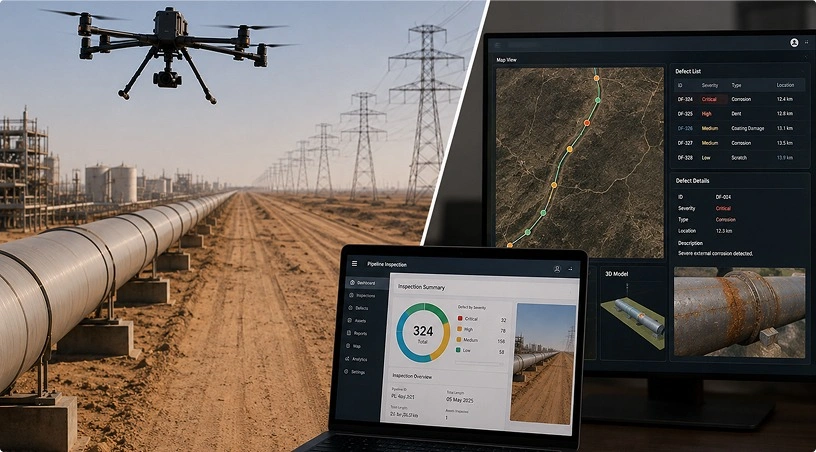
Captured data is not the deliverable. Processed findings are. This is the stage where the inspection either produces something the maintenance team can use, or produces a folder of files nobody opens. Processing covers photogrammetry, thermal analysis, defect classification, and alignment of findings to the asset register. An AI-powered analytics layer is what handles the volume: thousands of images per flight need to be reviewed, defects flagged, and severity classified against the operator’s own taxonomy.
The quality marker at this stage is traceability. Every flagged defect should link back to the source image, the exact location on the asset, and a severity classification the maintenance team recognises. According to McKinsey analysis of commercial drone applications, the value of drone inspection comes from the analytics stage, not the flight. Without traceability, findings cannot be verified or actioned.
Delivery is where most operators discover mismatches. A working deliverable set includes a defect register with location and severity, an annotated visual dataset such as an orthomosaic, 3D model, or thermal map depending on scope, a summary report tied to the maintenance system, and raw data archived for future comparison. The report should sit alongside the previous inspection cycle, not exist in isolation.
A common failure at delivery is a well-designed PDF with no underlying data structure. If the maintenance team cannot filter, sort, or export the findings, the report becomes decorative. Clarify at scoping stage which format the internal system consumes, and confirm the deliverable will match. Related: DJI Enterprise Industrial Inspection covers the payload combinations that feed different deliverable types.
A one-off drone inspection is useful. A repeating programme is where the operational value compounds. When the second and third inspection cycles are structured against the first as baseline, change detection becomes possible: new defects, growing defects, and unauthorised modifications all become visible. This is where inspection stops being a compliance exercise and becomes a monitoring system.
A managed programme should specify capture cadence, standardised processing, and delivery consistency across cycles. Dock-based autonomous operations, repeatable flight plans, and a single analytics platform holding the history are what make repeat cycles cheaper per cycle than the first. Guidance from the International Association of Oil and Gas Producers supports risk-based inspection frequency across industrial assets, where cadence scales with consequence rather than being uniform.
A drone inspection service in the UAE runs through six stages: planning, regulatory clearance, capture, processing, delivery, and (when the programme continues) repeat cycles. Each stage has its own quality markers, and operators who know what those markers look like are the ones who receive findings they can actually action. Judging quality only at delivery is too late.
If you are scoping a drone inspection programme in the UAE, Gulfnet Emirates delivers each stage under a managed service built for enterprise operators across all seven emirates.
How long does a UAE drone inspection project take from scoping to delivery?
A typical single-site inspection runs three to five weeks from scoping to delivered findings, split roughly between planning and clearances, capture, and processing. Larger or repeat programmes shorten this significantly on cycles two and three because plans, approvals, and processing pipelines are reused. Complex or restricted-airspace sites can extend timelines further.
What GCAA approvals are needed for drone inspections in the UAE?
GCAA operator certification is required for any commercial drone flight in the UAE, along with pilot licensing and aircraft registration. Additional approvals are needed for flights near controlled airspace, over populated areas, or beyond visual line of sight. Gulfnet Emirates handles all regulatory clearances end-to-end as part of every managed inspection programme.
What deliverables should I expect from a professional drone inspection?
A working deliverable set includes a defect register with location and severity, an annotated visual dataset such as an orthomosaic or 3D model, a summary report aligned to the maintenance system, and raw data archived for comparison. The exact combination should be agreed at scoping to match what the operator’s internal systems can consume.
How much does a drone inspection cost in the UAE?
Cost depends on asset type, site size, payload configuration, and cadence. A single-asset inspection typically ranges from a few thousand dirhams to five figures. Repeat programmes drive cost per cycle down significantly through reused plans, standardised processing, and dock-based autonomous operations on suitable sites.
Can drone inspections be repeated on a scheduled basis?
Yes. Repeating cycles are where operational value compounds, because change detection between cycles surfaces growing defects, new issues, and unauthorised site changes. Gulfnet Emirates delivers managed programmes with agreed cadence, standardised processing, and consistent deliverable formats so successive inspections can be compared cleanly across time.

 Go back