A quay wall can look sound from the deck while the real problem is developing several metres below the waterline. Scour around a pile, damaged coatings, exposed reinforcement, displaced blocks, marine growth hiding cracks, or debris around an intake may stay outside the clearest part of a diver’s view. For port operators, the problem is not simply getting someone underwater. It is getting a complete, reviewable record of submerged assets before a small defect becomes a berth restriction, emergency repair, or unplanned shutdown.
That is where ROV underwater inspection changes the job. It adds persistent visual coverage, recorded evidence, controlled close-up passes, and access to areas where human inspection becomes difficult or unsafe.
Commercial divers remain essential to many marine inspection programmes, especially when cleaning, tactile checks, measurements, or physical intervention are required. But the environment limits what any person can see and document.
The FHWA Underwater Bridge Inspection Reference Manual notes that many waterways have extremely limited visibility and that cameras and lights alone may not always produce an acceptable image. Earlier FHWA guidance also explains that, in low visibility, divers may need to rely on touch and may only be able to provide approximate measurements.
Ports add another layer of difficulty. Around piles, fenders, quay-wall cavities, suspended sediment, currents, marine growth, and restricted access points, an inspection may become a series of short observations rather than a continuous visual record engineers can revisit.
ROV inspection does not remove every limitation, but it changes the evidence available.
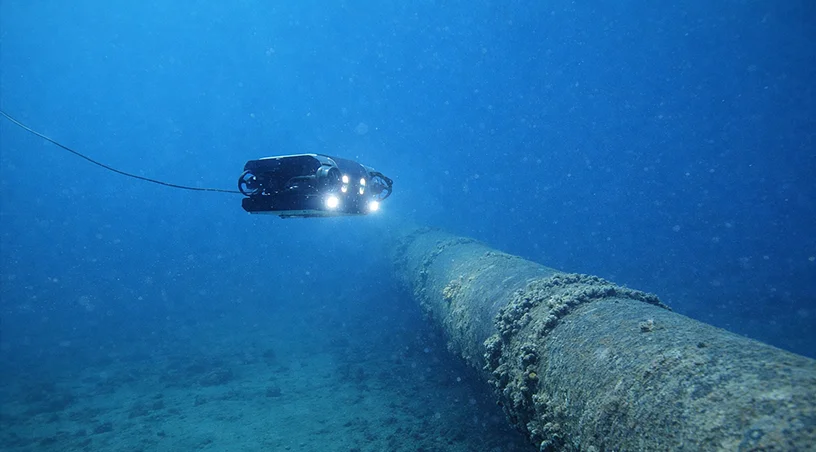
A remotely operated vehicle places a manoeuvrable camera system directly beside the submerged asset. Operators on the surface can watch the feed in real time, slow the pass around a suspicious area, revisit a location, and preserve video for engineering review.
For a port or terminal, that can support inspection of:
The value is not simply more footage. A route can be divided into sections, recorded in sequence, time-stamped, and compared with previous cycles. That gives engineers evidence they can revisit after site conditions change.
Also Read: Construction Monitoring for DP World’s Planned Fujairah Terminals
Underwater inspection is a safety decision before it becomes a data decision. The U.S. Army Corps of Engineers has been testing ROVs for aging aquatic infrastructure because some inspection environments are dangerous for divers and because robotic systems can enter tight areas without putting a person in the water.
That matters around active ports, where planning must account for vessel traffic, suction and discharge points, confined geometry, currents, entanglement hazards, and simultaneous operations.
Our ROV inspection capabilities for oil, gas and marine assets are built around deploying remotely operated vehicles for submerged structures, foundations, pipelines and risers while providing recorded visual documentation for engineering review.
The stronger model is to use robotic inspection where remote visual assessment, repeatable documentation, or higher-risk access is the priority, then deploy divers where hands-on verification, cleaning, NDT, repair, or intervention is required.
The difference between useful ROV footage and hours of underwater video is the inspection plan.
Start by defining what the engineering team needs to decide. Scour, impact damage, coating loss, blockage, cracking, deformation, corrosion, and unknown anomalies each demand different routes, camera distances, lighting, pass speeds, and follow-up sensing.
In our inspection work, we follow a practical sequence: define the inspection objective, deploy the appropriate robotic system, capture the required visual or sensor data, process and analyse what was collected, then turn the findings into information the asset team can act on.
One of our published seawater intake pipeline inspection case studies shows the same principle in a confined marine asset. The ROV was used for full-length internal visual surveying, weld inspection, marine-growth identification, sediment detection and obstruction verification, with time-stamped recorded evidence retained for post-mission review.
For a port, the mission should produce a traceable condition record, not simply a successful deployment.
The biggest operational gain often appears between inspections.
A structured ROV record lets the team return to the same location during the next cycle and ask a more useful question: has the defect changed?
That comparison matters when engineering teams are deciding whether to monitor, repair, restrict operations, or escalate to a more detailed inspection method. Recorded footage can also be shared across civil, marine, HSE, maintenance, and contractor teams for joint review.
ROVs also make targeted follow-up easier. If a suspicious joint or pile is identified, the operator can revisit that exact zone for a slower pass. If visual evidence remains inconclusive, the inspection can then escalate to cleaning, sonar, thickness measurement, diver verification, or other NDT methods.
ROV visual inspection is not a substitute for every underwater technique. FHWA guidance notes constraints including strong currents, turbidity, tether management, and positioning. Good planning chooses the technology around the site, not the reverse.
The real question is not whether a diver or ROV wins the inspection. It is whether the port receives enough reliable evidence to make the next maintenance decision with confidence.
For submerged assets, ROVs can extend visual access, reduce personnel exposure, create repeatable coverage, and simplify targeted reinspection. Divers remain valuable when the task requires touch, cleaning, measurement, NDT, or physical intervention.
For Gulf ports managing quay walls, piles, intakes, submerged pipelines, fenders, and foundations, that creates a more practical inspection framework: identify the risk, capture the underwater condition systematically, preserve the evidence, and escalate only where deeper intervention is needed.
At Gulfnet Emirates, we support this approach through our Enterprise Drones, Robotics & AI-Powered Solutions, including ROV inspection for hard-to-reach underwater assets and marine infrastructure. If your next maintenance decision depends on what is happening below the waterline, the right starting point is a scoped inspection plan built around the asset, access conditions, and evidence your engineers actually need.
Related: Offshore Platform Inspection with Drones: Emergency Response and Routine Monitoring
What is ROV underwater inspection for ports?
ROV underwater inspection uses a remotely operated vehicle with cameras, lighting, and mission-specific sensors to examine submerged port assets from the surface. It can document quay walls, piles, foundations, pipelines, intakes, fenders, scour zones, and obstructions while giving engineering teams recorded evidence for review, comparison, maintenance planning, and follow-up decisions.
Can ROV inspection replace commercial divers at a port?
Not completely. ROVs are well suited to remote visual inspection, repeatable documentation, difficult access, and higher-risk areas. Divers remain important when the job requires tactile examination, cleaning, measurements, NDT, sampling, or physical repair. Port programmes often gain more value by assigning each method to the task it performs best underwater.
What port defects can an underwater ROV help identify?
An ROV can help document visible cracking, coating deterioration, corrosion, displaced material, scour, marine growth, sediment, debris, obstructions, damaged connections, and changes around submerged structures. What it can confirm depends on visibility, access, camera position, sensors, and scope, so findings may still require targeted verification, cleaning, direct measurement, or NDT.
How does ROV inspection support preventive port maintenance?
Recorded ROV footage gives teams a condition baseline that can be revisited during later inspections. Engineers can compare the same location across inspection cycles, check whether deterioration is progressing, prioritise follow-up work, and decide where closer investigation is justified rather than treating every submerged asset as an equal maintenance priority.
How should a port choose an ROV inspection provider?
Start with the inspection outcome, not the ROV model. The provider should understand marine operating risks, define a structured route, match the system and sensors to site conditions, preserve traceable footage, and deliver findings engineers can review. We scope the mission around asset type, access, risk, evidence, and reporting needs.
 Go back