If you are evaluating drone inspection services for the first time, the lack of standardized pricing across the UAE market makes it difficult to know whether a quote is competitive, inflated, or missing critical deliverables. Costs vary significantly depending on asset type, sensor requirements, site complexity, and reporting depth.
This blog breaks down the key factors that drive drone inspection pricing in the UAE and GCC, provides realistic cost benchmarks by industry, and gives you a practical approach to budgeting based on total value, not just the flight fee.
There is no single rate card for drone inspections because the cost is shaped by several variables that change from project to project.
1. Asset Type and Complexity
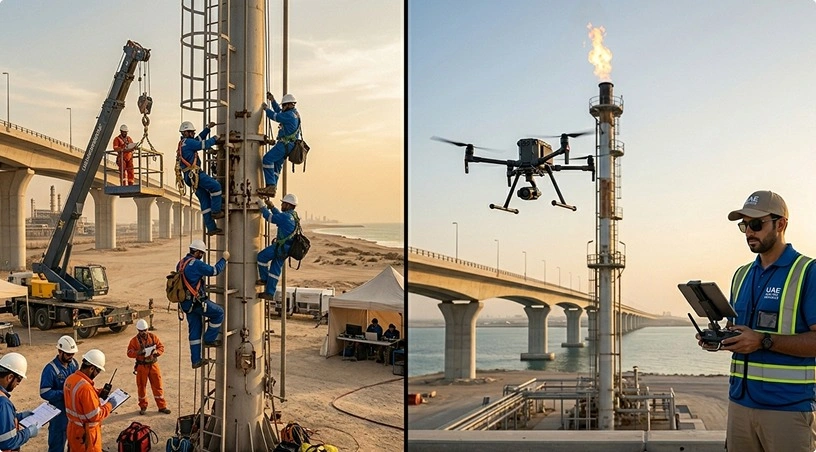
These are the primary cost drivers. Inspecting a single telecom tower is a fundamentally different scope than surveying a 200-hectare solar farm or assessing a live refinery with active flare stacks. Taller structures, confined spaces, hazardous zones, and multi-angle coverage requirements all increase flight time, pilot workload, and safety planning.
2. Sensor and Payload Requirements
Sensor and payload directly affect pricing. A basic visual inspection using a high-resolution RGB camera costs less than a mission requiring simultaneous thermal imaging, LiDAR mapping, or gas detection. Multi-sensor missions cost more per flight, but they eliminate the need for separate inspection passes, which often makes them more cost-effective overall.
3. Site Location and Accessibility
These play a significant role in the overall pricing. Remote desert pipeline corridors, offshore platforms, and facilities spread across multiple emirates require mobilization costs and specialized logistics. An inspection provider with regional teams stationed across the GCC can respond faster and reduce mobilization overhead compared to flying a crew from a single base.
4. Reporting Depth and Data Deliverables
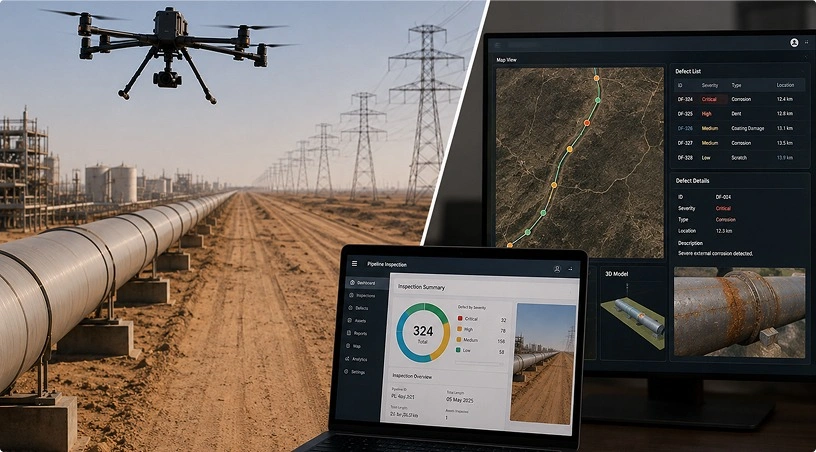
This is where quotes diverge most. Some providers price only for the flight and raw imagery. Others include geo-referenced defect maps, severity classifications, thermal analysis, 3D models, and integration with asset management platforms. The flight itself may account for only 30 to 40% of total project value; analysis and reporting represent the remaining 60 to 70%. When comparing quotes, always clarify what is included.
(Also Read: Drone vs Manual Inspection: A Cost-Benefit Analysis for UAE Construction Projects)
While exact pricing depends on the variables above, the following benchmarks reflect typical ranges across the UAE and GCC market.
Building and facade inspections generally fall between AED 3,000 and AED 10,000 per structure, depending on height, number of facades, and whether thermal imaging is included alongside visual assessment.
Solar farm inspections are typically priced per megawatt of installed capacity, ranging from AED 150 to AED 400 per MW, with volume discounts for larger arrays or multi-site contracts. This is a fraction of what manual thermography crews charge for equivalent coverage.
Oil and gas facility inspections, including flare stacks, storage tanks, and pipeline corridors, range from AED 5,000 to AED 25,000 per asset depending on complexity, HSE requirements, and specialized payloads involved.
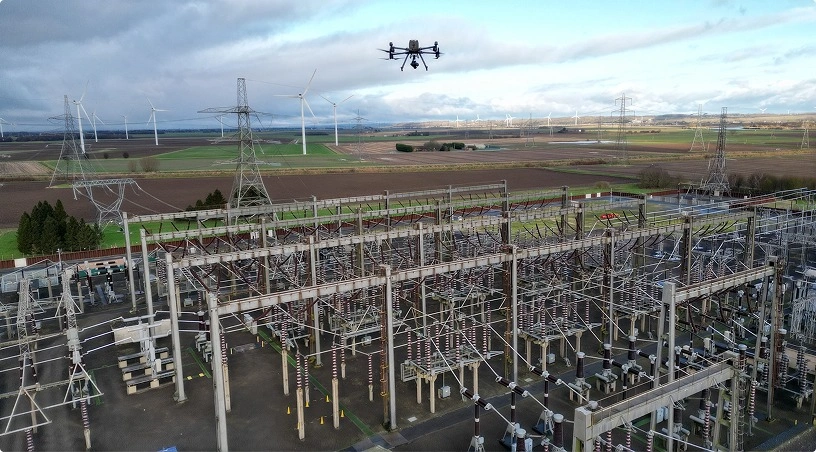
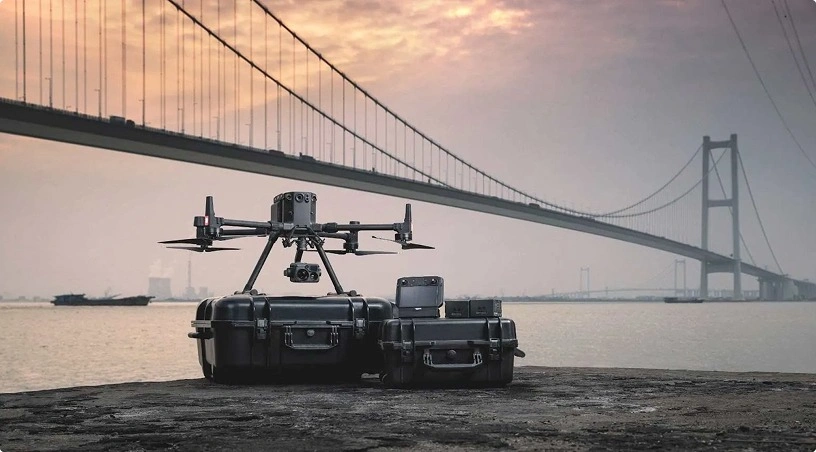
Infrastructure inspections for bridges, power lines, and telecom towers typically range from AED 2,500 to AED 8,000 per asset.
For organizations establishing ongoing programs with quarterly or semi-annual cycles, annual contract pricing often reduces per-inspection costs by 20 to 35% compared to one-off engagements.
Traditional approaches carry substantial costs that extend well beyond the inspection itself. Scaffolding erection and dismantling for a single storage tank or flare stack can cost AED 50,000 to AED 150,000, before accounting for the inspection work. Rope access teams require specialized safety supervision and often limit simultaneous access. Both methods typically require partial or full production shutdowns, and the cost of lost output frequently exceeds the inspection fee itself.
Drone inspections eliminate scaffolding, reduce crew sizes, compress multi-day timelines into hours, and in most cases require no production shutdown. The 40 to 70% cost savings widely reported across the GCC reflect not just direct inspection fees, but total operational cost including access preparation, safety overhead, and downtime avoidance.
Not all quotes are structured the same way, and the lowest price does not always represent the best value.
1. Regulatory compliance and pilot certification. Confirm that the provider operates with GCAA-certified pilots and handles all flight permits, risk assessments, and HSE coordination. Cutting corners on compliance creates liability exposure.
2. Deliverable scope. Clarify whether the quote covers raw imagery only or includes processed reports with defect classification, severity mapping, and GPS coordinates. If you need deliverables that integrate with your CMMS, confirm that the provider supports this through a centralized data platform rather than static PDF reports.
3. Multi-sensor capability. Verify that the provider can deploy the sensor combinations your assets require (thermal, LiDAR, gas detection, high-resolution zoom) without subcontracting to third parties.
4. Regional coverage and response time. For organizations managing assets across multiple emirates or GCC countries, a provider with distributed teams delivers faster mobilization and lower logistics costs.
Budgeting for drone inspection in the UAE comes down to four dynamics: asset complexity and sensor requirements drive the base cost, reporting depth determines deliverable value, comparison against traditional methods reveals true savings, and provider capability (compliance, multi-sensor expertise, regional coverage, data platform integration) determines whether the investment translates into actionable maintenance outcomes. When evaluated together, the conversation shifts from “what does a drone flight cost” to “what does better asset visibility save us.”
Gulfnet provides end-to-end drone inspection services across the UAE and GCC, covering industrial facilities, energy infrastructure, solar farms, buildings, and pipeline networks. As an authorized DJI Enterprise dealer with GCAA-certified pilots, multi-sensor platforms, and centralized reporting through Gulfnet Insight®, we deliver inspection programs designed to integrate with your existing maintenance workflows.
Get in touch for a free consultation and customized pricing proposal: www.gulfnetemirates.com/dronesandrobotics
1. How much does a basic drone inspection cost in the UAE?
Basic visual drone inspections for commercial buildings and infrastructure in the UAE typically start from AED 2,500 to AED 5,000 per asset. Pricing increases with building height, multi-sensor requirements, and the depth of post-processing and reporting deliverables included in the scope.
2. Is drone inspection cheaper than scaffolding for industrial assets?
Yes. Drone inspections typically cost 40 to 70% less than scaffolding-based methods when accounting for equipment rental, erection labour, safety supervision, and production downtime. For assets like flare stacks and storage tanks, the savings are especially significant.
3. What is included in a professional drone inspection quote?
A comprehensive quote should cover mission planning, GCAA-compliant flight operations, multi-sensor data capture, post-processing, geo-referenced defect reports with severity classification, and delivery through a centralized data platform. Always confirm whether raw imagery or processed deliverables are included.
4. Do drone inspection providers in the UAE offer annual contracts?
Yes. Most established providers offer annual or multi-year contracts for organizations with recurring needs. Contract pricing typically reduces per-inspection costs by 20 to 35% compared to one-off engagements, with benefits like priority scheduling and historical trend tracking.
5. How do I compare drone inspection quotes from different providers?
Compare on four dimensions: regulatory compliance and pilot certification, sensor and payload capabilities, deliverable depth (raw imagery versus processed reports with defect classification), and regional coverage. The lowest flight fee may exclude critical reporting that determines the inspection’s value.

 Go back