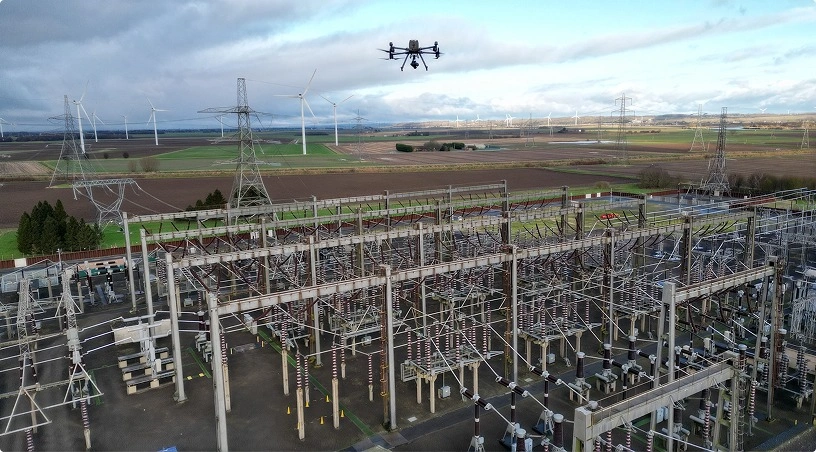
You have days, not weeks, to capture a clean thermal baseline of every joint, bushing, and connector on a newly energised 132kV substation before the handover certificate goes in.
Miss that window, and you hand DEWA an asset with no defect baseline. Any warranty claim over the next twenty-four months on a hot joint or a failed bushing then lands on your desk, not the OEM’s, because there is no dated evidence of when the anomaly first appeared.
Multiply that exposure across the 65 substations DEWA is currently building and the 30 more tenders it plans to issue, and inspection stops being a commissioning line item and starts driving commercial risk.
This blog lays out a five-window inspection cadence, tied to a new substation’s operating lifecycle, that closes the gap from day one.
According to DEWA’s official announcement in July 2026, the utility’s strategic transmission investments have crossed AED 10 billion, with 402 transmission substations already in service and a further 65 substations plus 340km of underground cable extensions in the pipeline. At that volume, the bottleneck is no longer whether inspection is possible on a single asset. It is whether the same specification can be repeated across 30 or 50 substations in a rolling window without draining commissioning teams or delaying energisation.
Before treating drones as a general answer, it helps to enumerate what a fresh substation genuinely requires. The mandatory items break into four categories. First, geometric verification of the yard against the as-designed layout, including bus-bar clearances, gantry positions, and transformer bund geometry. Second, visual condition capture of every energised surface after first load. Third, thermal signature capture of the whole yard once load is stable, so hot joints and defective bushings can be caught before they cause a trip. Fourth, recurring surveys through the warranty period, because vendor claims for early-life defects depend on documented evidence of when the anomaly first appeared.
An aerial platform equipped with a high-resolution optical payload, a calibrated radiometric thermal camera, and a LiDAR sensor covers all four categories in a single mobilisation. Scaffold and handheld thermography still work on a single substation, but stop scaling the moment the count runs into the dozens.
Every substation, from a single-bay 132kV asset in Al Barsha South to a 400/132kV node like Saih Al Dahal, moves through five distinct inspection windows in its first eighteen months, each anchored to a different operational objective.
Window one, pre-energisation baseline. Before the yard is live, an optical and photogrammetric pass documents installed condition, verifies clearances, and produces a geo-referenced 3D model that doubles as the substation’s as-built record. This becomes the reference dataset every future inspection compares against, and the geospatial anchor the operator loads into its asset register.
Window two, first-load thermal signature. Within days of energisation, a radiometric thermal sweep captures the baseline temperature profile of every joint, connector, and bushing under real electrical stress. Warranty and defect investigations anchor to this dataset.
Window three, warranty-period recurring surveys. Through the twelve to twenty-four month contractor warranty window, quarterly sweeps catch emerging hot joints, cable-head corrosion, and settlement at transformer plinths while those defects are still the contractor’s obligation to remedy. Because each sweep is captured to the same specification, a joint drifting from 45°C at first load to 68°C at month nine is flagged automatically, not spotted by chance.
Window four, steady-state predictive cadence. After the warranty period, semi-annual or annual thermal and visual sweeps feed the operator’s condition-based maintenance system with comparable data across the fleet.
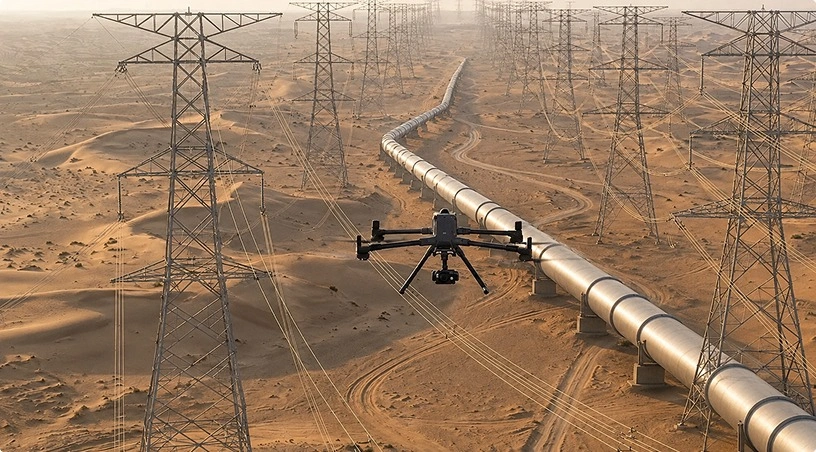
Window five, corridor tie-in surveys. New substations rarely exist in isolation. Aerial LiDAR combined with optical inspection along connecting overhead and underground routes closes the loop between the yard and the wider grid. Our earlier piece on drone-based power line inspection for UAE utilities walks through the sensor mix and defect catalogue in detail.
DEWA’s H1 2026 programme included 20km of extended 132kV cables, 117km of new 400kV overhead lines from Saih Al Dahal, and contracts for a further 64km of 132kV cable extensions. Overhead corridor work uses the same aerial platform deployed at the yard, with LiDAR added for conductor clearance verification and vegetation encroachment mapping.
Underground routes are covered with aerial photogrammetry to document trench alignment, backfill condition, and joint bay locations directly into the operator’s GIS record. The economics of that corridor mapping, and how survey-grade point clouds pay back over a project’s life, are treated in our companion analysis of LiDAR survey ROI for GCC infrastructure.
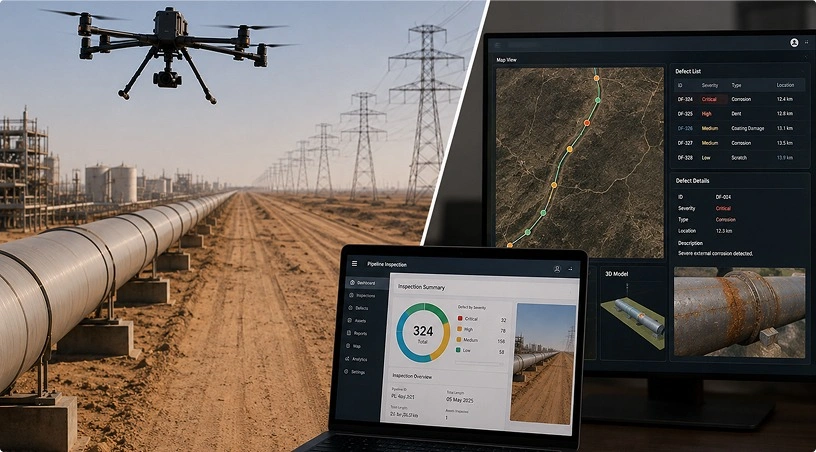
Aerial capture is only as valuable as the data pipeline behind it. Radiometric thermal imagery must be tagged to the exact asset ID in the operator’s register. Optical imagery has to be geo-referenced against the yard model so defect location is unambiguous in a warranty submission. Point-cloud data from corridor surveys must export cleanly into the operator’s asset management platform without a manual reformatting step. Analytics platforms such as Gulfnet Insight hold those layers together in a single environment, so the yard model, the thermal history, and the defect register move as one dataset from window to window. Teams building this capability typically start with a specialist power and utilities inspection practice that runs the analytics stack alongside the field crew.
The value of the five-window cadence is not any single flight. It is the compounding effect of comparable data captured at the right moments, so each window strengthens the evidence base for the next. Applied across the DEWA pipeline, the discipline turns inspection events into a fleet-level intelligence programme, and shifts inspection spend from a recurring cost line into a durable data asset the operator draws on for the life of the yard.
Ready to build an inspection cadence around your DEWA transmission portfolio? Gulfnet Emirates operates GCAA-certified pilot teams, radiometric thermal and LiDAR-equipped platforms, and an analytics workflow tuned to substation and corridor work in Dubai. Contact the Gulfnet Drones and Robotics team to scope a cadence for your next commissioning package.
Can drones inspect a 132kV or 400kV substation while it is fully energised?
Yes. Certified aerial teams use approved standoff distances and enterprise platforms with high-zoom optical and radiometric thermal payloads to capture bushings, connectors, and bus-bar joints under load. There is no need to de-energise the yard, which protects the commissioning schedule and captures thermal signatures under real electrical stress.
How often should a newly commissioned DEWA substation be inspected by drone?
A typical cadence covers five windows: pre-energisation baseline, first-load thermal within days of energisation, quarterly warranty-period sweeps for the first eighteen to twenty-four months, then semi-annual or annual steady-state inspections. Corridor surveys along connecting transmission lines run in parallel on a project-driven cadence.
What deliverables does a drone-based substation inspection produce for the operator?
Standard deliverables include radiometric thermal imagery tagged to asset IDs, high-resolution optical imagery geo-referenced against the yard, a defect register with severity classification, comparative reports across inspection windows, and, for corridor work, a LiDAR point cloud with conductor clearance measurements ready for the operator’s asset management system.
Are aerial substation inspections in Dubai compliant with GCAA and DCAA regulations?
Yes, when the operator holds valid GCAA commercial authorisation and coordinates DCAA airspace approvals for Dubai flights. Substation work also requires site-owner permits and coordination with the operator’s control centre. Certified providers manage this approval chain in advance, so flight windows align with the commissioning or maintenance schedule.
What is the ROI of moving substation inspection from scaffold to drone-based capture?
The return compounds across three dimensions: schedule protection during commissioning, reduced fall and electrical exposure risk, and a consistent digital dataset that supports warranty claims and condition-based maintenance. For a portfolio the size of DEWA’s build, the per-substation saving multiplies quickly across the fleet.

 Go back