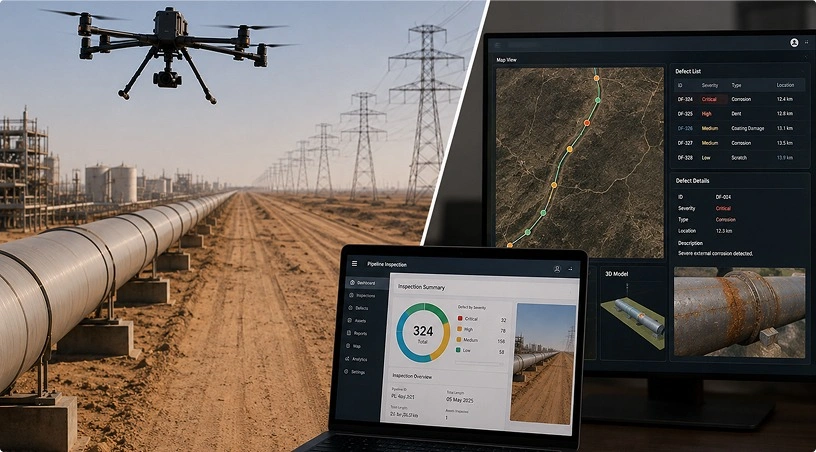

If you are procuring drone inspection services for a refinery, substation, tower portfolio, or infrastructure asset in the UAE, the shortlist you build in the first two weeks will decide whether the programme delivers usable data or a compliance headache twelve months later. The market ranges from single-pilot operators with a consumer-grade drone to enterprise providers with certified fleets, in-house analytics, and multi-emirate authorisation. The gap is rarely visible in a proposal document. This blog gives you a diagnostic framework for evaluating providers on the criteria that actually predict programme outcomes, drawn from our field experience across oil and gas, utilities, construction, and infrastructure engagements in the region.
Most underperforming engagements are not technology failures. They are procurement failures. The provider was selected on price or proximity, then discovered mid-project to lack a specific authorisation, a payload class, an analytics workflow, or the mobilisation capacity to match the schedule.
We see this pattern repeat across sectors. A solar operator commissions a thermal sweep and receives raw imagery without defect classification. An infrastructure owner books a bridge inspection and learns the provider does not hold flight authorisation for the airspace corridor. A refinery contracts a flare inspection and reschedules twice when the pilot cannot maintain safe standoff distances. The criteria below map to the failure modes we observe most frequently.
Every commercial drone operation in the UAE requires GCAA Unmanned Aircraft Operator Authorisation, registered aircraft, and certified pilots per the UAE Government’s aviation safety framework. This is the baseline. What you should verify beyond it depends on where your assets sit.
Abu Dhabi asset operations require security clearance from the General Headquarters (GHQ) of the Armed Forces and coordination with local transport authorities. Sites near DXB, AUH, or restricted zones require per-flight clearances that a provider without established relationships with the relevant authorities cannot secure on short notice.
Request the operator authorisation number, the list of registered aircraft, and pilot certificate references before requesting a quote. A provider that treats these as sensitive information rather than standard disclosure is a signal in itself.
An enterprise drone inspection provider is only as capable as the payload and platform combination they can bring to your specific asset. A generalist mapping drone will not deliver useful data on a flare stack. A visual-spectrum-only fleet cannot detect subsurface delamination on a bridge deck. A provider without radiometric thermal capability cannot classify hotspots on a solar array.
Match the fleet to the outcome you need. For structural inspection, close-range flight capability under decks and around piers matters more than headline flight time. For solar and utility thermal work, radiometric calibration and repeatable flight paths matter more than aircraft brand. For pipeline corridors, autonomous dock-based operations change the entire cost model.
Our own managed inspection services use the Matrice 4 Thermal for close-range structural and thermal work, larger enterprise platforms for wide-area survey, and dock-in-a-box configurations where remote autonomous flights make operational sense. The right provider maps platform choice to your outcome, not the reverse.
Also Read: Drone vs Manual Inspection: A Cost-Benefit Analysis for UAE Construction Projects
Data capture is the easy part. Data delivery is where most engagements quietly underdeliver. Three questions expose the gap.
First, what does the final deliverable actually contain? Raw imagery is not an inspection report. You need defect classification, severity tagging, geo-referenced anomaly maps, and a format that integrates with your asset management workflow.
Second, how is the data hosted and who controls access? Cloud-hosted platforms with role-based permissions are the current enterprise standard. Providers who deliver findings as email attachments create both a compliance and a continuity risk.
Third, does the platform support inspection-to-inspection comparison? A single snapshot has limited operational value. Trend analysis across successive cycles is where drone-based programmes begin outperforming manual ones. This is what we build into Gulfnet Insight for every managed inspection engagement, so operators act on trajectory rather than isolated points.
A provider that operates well in October is not necessarily a provider that operates well in July. Coastal humidity, salt-laden air, dust events, and 50°C ambient temperatures degrade both hardware and mission planning assumptions. Ask how the provider handles thermal derating on flight endurance, how their airframes are maintained after coastal deployments, and what their historical mission completion rate looks like during summer months.
Mobilisation capacity is the other reliability dimension. Assets scheduled around turnaround windows cannot wait for a provider to recruit additional pilots. GCAA-certified pilot teams distributed across Abu Dhabi, Dubai, and the Northern Emirates can respond within hours. Providers routing every deployment from a single office cannot match that profile.
Three contractual details matter more than most procurement checklists suggest.
Data ownership terms should state that the client owns the raw data, processed outputs, and derivative reports. Some providers reserve rights to inspection data for their own model training or resale, creating both a compliance issue and an asset intelligence leak.
Liability and insurance coverage should reflect the operational environment. A provider inspecting a live refinery, a public bridge, or an energised substation should carry commercial liability coverage that a hobbyist policy would not extend to.
Deliverable timelines should be defined in the contract, not left to post-award clarification. A defined turnaround on preliminary findings and full reporting protects your maintenance schedule and keeps the engagement measurable.
Choosing the right drone inspection provider in the UAE is a diagnostic exercise, not a scoring exercise. Verify the regulatory credentials, match platform and payload capability to your asset class, interrogate the data delivery workflow, test the provider against real operating conditions, and lock the contract terms that protect your data and schedule. When these five criteria hold, the engagement delivers what the procurement case promised. When one fails, the failure mode is predictable.
At Gulfnet Emirates, we deliver full lifecycle inspection management across oil and gas, utilities, infrastructure, renewables, and construction sectors in the UAE and wider GCC. As an authorised DJI Enterprise dealer with GCAA-certified pilot teams and the Gulfnet Insight analytics layer, our Enterprise Drones, Robotics and AI-Powered Solutions are configured for the operational conditions your assets actually face. Talk to our team to scope your next inspection programme.
Related: Bridge Inspection with Drones: Safer and More Efficient Infrastructure Assessment
What is the minimum regulatory authorisation a drone inspection provider must hold in the UAE?
Commercial drone operators must hold GCAA Unmanned Aircraft Operator Authorisation with registered aircraft and certified pilots. Emirate-level permits from DCAA in Dubai or military security clearance in Abu Dhabi may also apply depending on airspace and asset location. Always request documentation before shortlisting any provider for enterprise inspection work.
How do I confirm a drone inspection provider has the right payload for my asset?
Ask the provider which platform and payload combination they will assign to your inspection, and why. Structural inspections need close-range flight and thermal or high-zoom optical payloads. Solar and utility work needs radiometric thermal calibration. A provider unable to justify payload selection against your asset class is not a fit.
What data deliverables should an enterprise drone inspection contract include?
The contract should specify defect classification with severity ratings, geo-referenced anomaly mapping, compatibility with your asset management system, and cloud-hosted access with role-based permissions. Raw imagery alone is insufficient. Inspection-to-inspection comparison capability is the differentiator that separates managed programmes from one-off engagements delivering isolated snapshots.
How quickly should a UAE drone inspection provider be able to mobilise?
For scheduled inspection cycles, mobilisation should follow the timeline agreed at contract award. For unplanned or emergency needs, providers with distributed teams across Abu Dhabi, Dubai, and the Northern Emirates typically respond within hours. Providers routing every deployment from a single office cannot match this response profile, particularly during peak operational seasons.
Who owns the inspection data captured by a drone service provider?
Contract terms should confirm that the client owns the raw data, processed outputs, and derivative analytics. Some providers reserve rights for internal model training or resale, which creates compliance and asset intelligence risk. Verify data ownership language in the master service agreement before signing any commitment.


 Go back